


Real-World Insights for Brave Workplaces: Beyond Disability Compliance
The Backyard
For those new to this newsletter, The Backyard is where I step away from frameworks and public-facing work and share something quieter. A moment behind the scenes that helps explain why the work matters to me.
Lately, I’ve been thinking a lot about time.
Not in the productivity sense, but in the fragility sense. How quickly things can change. How little control we actually have over what’s coming next. And how easy it is to postpone rest, connection, and recalibration because we assume there will always be another window.
Last fall, I wrote about the importance of stepping away, of creating space to recover and reset. That reflection has stayed with me more than I expected. Not because I needed more vacation, but because it reminded me how often we defer the things that actually sustain us.
Two months into the year feels like a quiet checkpoint. A chance to ask whether the way we’re moving through work and life reflects what we truly value, or just what we’ve learned to tolerate.
We don’t always get advance notice when life asks us to slow down. Sometimes the most courageous thing we can do is make that adjustment before we’re forced to.
Two Months In: What’s Actually Working, and What Are You Willing to Change?
We’re a little more than two months into 2026.
The urgency of January has faded. The optimism has softened. And for many people, there’s a quiet realization setting in.
This doesn’t feel as different as I thought it would.
That’s not failure.
That’s information.
This is the point in the year where clarity shows up not in goals, but in patterns. The way work actually gets done. The way decisions actually get made. The way time, energy, and responsibility are actually distributed.
And it’s often uncomfortable.
Because what becomes clear isn’t that we didn’t try hard enough. It’s that the systems we’re operating in, professionally and personally, haven’t really changed.
Courage Isn’t Grit. It’s Adjustment.
As a culture, we talk a lot about courage as persistence. About pushing through. About staying the course.
But two months into the year, courage often looks like something quieter and harder.
It looks like admitting that something isn’t working, even if it’s familiar, even if it’s what you’re known for, even if it’s how things have always been done.
It looks like letting go of the idea that the solution is more effort, when what’s actually needed is better design.
I see this all the time in organizations. Leaders pushing teams harder instead of redesigning broken workflows. HR professionals absorbing risk instead of being empowered to fix the systems creating it. Employees burning out not because they lack resilience, but because the structure around them makes sustained performance impossible.
We don’t need more grit.
We need better systems.
The Quiet Cost of “Just Keep Going”
Here’s what often happens by March.
People start compensating for what isn’t working.
They work longer hours.
They carry more emotional load.
They fill gaps instead of questioning why the gaps exist.
And over time, that compensation becomes invisible. Until it isn’t.
Burnout, disengagement, accommodation breakdowns, leave spikes, and employee relations issues aren’t sudden events. They’re signals that show up when systems ask people to do what the structure won’t support.
Courage at this point in the year is noticing those signals early and responding thoughtfully, not waiting until something breaks.
Three Questions Worth Sitting With
Instead of a checklist or a new goal, I’ll offer three questions. Not to answer quickly. Just to sit with honestly.
Where am I relying on effort instead of design?
What am I personally propping up that should actually be fixed?
What am I tolerating because it’s familiar, not because it’s effective?
This applies to processes, roles, expectations, and sometimes relationships.
What would change if you stopped managing people and started managing systems? This is as true at work as it is at home.
These questions aren’t about doing more. They’re about choosing differently.
My Voice
In past issues, this section has highlighted where my voice has been showing up on national stages and in public conversations.
This time I’m doing something a little different. I don’t want to talk about where my voice is showing up in headlines or on panels. I want to focus on showing up here, with you.
This is the part of the year when the noise fades and the patterns become harder to ignore. When we start to see what’s working, what isn’t, and where we’re compensating instead of redesigning.
If you’re feeling tired, stuck, or quietly frustrated, it’s probably not because you lack discipline or ambition. It’s more likely because you’re carrying systems that were never designed to support how work really happens.
Courage at this point in the year isn’t about pushing harder.
It’s about adjusting without shame.
It’s asking where effort is masking broken design.
It’s noticing what you’re tolerating because it’s familiar, not effective.
It’s choosing to redesign instead of endure.
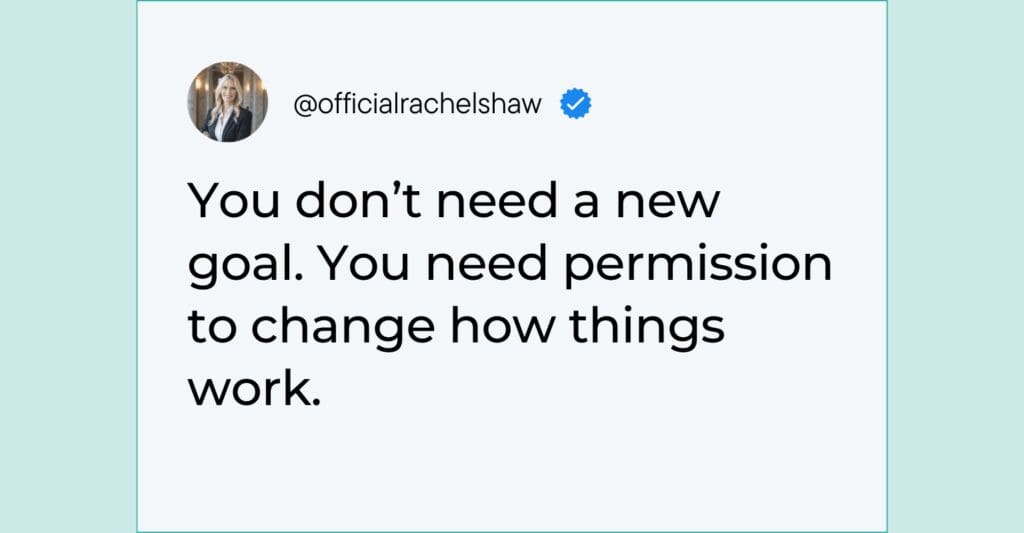
You don’t need a new goal.
You need permission to change how things work.
Sometimes the most courageous thing you can do is stop forcing what no longer fits and build something better instead.
A Closing Thought
Two months into the year isn’t too late to change course.
It’s early enough to do it well.
Courage doesn’t always announce itself loudly. Sometimes it shows up as a quiet decision to stop forcing what no longer works and to build something better instead.
That’s where real momentum comes from.
Until next time,
Rachel


view + leave comments . . .