


Real-World Insights for Brave Workplaces: Beyond Disability Compliance
The Backyard
The Second Act
A few years ago, I attended a conference where Jane Fonda was speaking. She talked about what she calls the “third act” of life—describing it in three phases, not as something rigid, but as a way of understanding how we evolve, how we grow, and how we decide what matters next.
As I listened to her, two things struck me. First, I realized that I wanted to make a change in my career. And second, I was deeply aware of how fortunate I am to even have the opportunity to consider that kind of change.
I know so many people who work incredibly hard just to meet the demands in front of them. I understand how lucky I am to be in a position where I can think about shifting my work toward what I want to do more of, not just what I need to do.
For those of you who have been with me for a long time, you know that nearly 26 years ago I began working in ADA, FMLA, and disability compliance. Fifteen years ago, I built Shaw HR Consulting, and more recently, I launched Rachel Shaw, Inc. For much of that time, my work was deeply rooted in individual case management, working directly with employers and employees to navigate complex situations and find solutions.
It was meaningful work—work I’m incredibly proud of. But it was also, by its nature, one case at a time.
As I began thinking about what I wanted my second act to look like, one idea became very clear: I wanted to create more impact. For me, that meant focusing more on system-level change within organizations and expanding the reach of my training work across the country.
And I have genuinely loved that shift.
But even as I leaned into this next phase, I realized there was something I missed.
What I missed was the moment.
That moment when someone is in the middle of a situation that feels complex, high-stakes, and uncertain, and they need to think it through with someone.
I didn’t miss the volume.
But I did miss the impact.
And that led me to a different question:
How do I bring that back…without going backward?
My Voice
That question stayed with me.
Because I knew I didn’t want to go back to managing hundreds of cases. I had already made the decision to focus on training and helping organizations build stronger internal programs—and I knew that was the right direction.
But I couldn’t ignore what I was missing.
What I missed was being in it with people in real time. Helping them think through a situation, ask better questions, and find a path forward when the answer wasn’t obvious.
If you do this work, you know exactly what I mean.
These decisions are rarely clean. They don’t come with perfect information or clear answers. They happen in real time, often under pressure, and they require judgment—not just knowledge.
And that’s when it clicked.
The issue isn’t that people don’t know the law.
The issue is that there are very few opportunities to practice applying it in a way that builds real confidence.
Because the truth is, people don’t get better at this work by reading policies or attending one-off trainings.
They get better through experience.
Through repetition.
Through thinking it through.
Through getting it wrong, adjusting, and trying again.
But in our world, experience comes at a cost.
More cases.
More risk.
More pressure.
And most people are already at capacity.
So the question became:
Is there a way to build decision-making skill without adding more to someone’s workload?
That question is what led to the creation of the ADA Decision Lab which launches July 7, 2026.
The ADA Decision Lab is a 25-week live learning experience where I train, answer questions, and coach live to support learning without the workload. Confidence building with less risk.
What I have missed was being in it with people in real time. Helping them think through a situation, ask better questions, and find a path forward when the answer wasn’t obvious. I am so excited to launch this missing piece of my Second Act.
Bigger Impact. More Connection.
If you are interested in joining the Lab, details are below.
––
COACHING CORNER
A Tool for the Moments That Feel Hard: The Cognitive Triangle
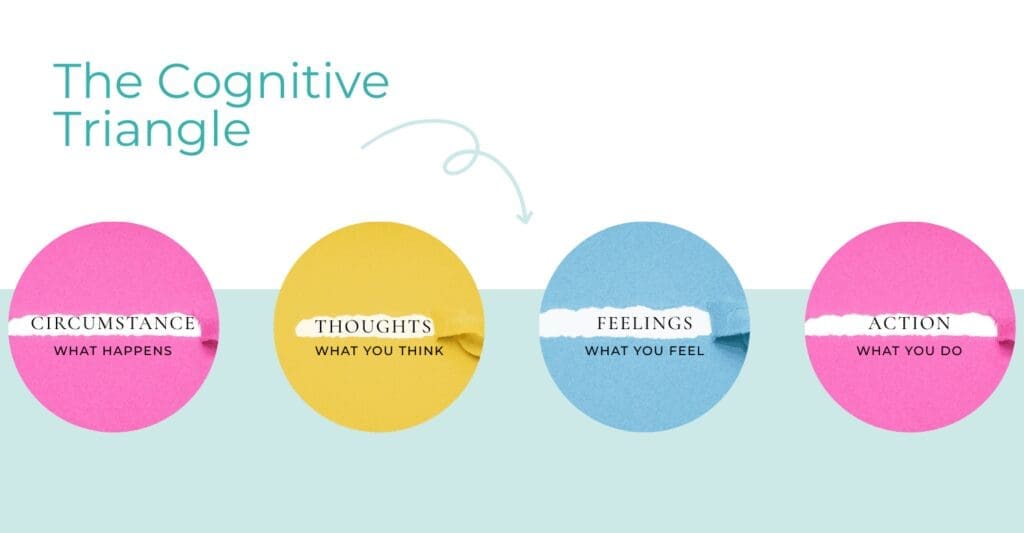
I want to share a simple tool that came out of a recent client call—one of those moments that reminded me exactly why this work matters.
A senior leader was pushing HR to schedule a Fitness for Duty exam before an employee returned. The employee believed they were being released, and the supervisor was concerned they weren’t ready.
My client felt stuck. Not because she didn’t know the law—but because she felt pressure. If she didn’t move forward, she believed it could escalate and reflect poorly on her.
And in that moment, fear started driving the decision.
This is where the Cognitive Triangle becomes incredibly helpful.
At its core, it shows how quickly our brains work:
- A situation happens.
- We have thoughts about it.
- Those thoughts create feelings.
- Those feelings drive actions.
In this case, the situation was simple: A supervisor requested an FFD.
But the thought was: If I don’t do this, this is going to escalate and I’ll be judged.
That thought created fear—and the action she was preparing to take was to move forward, even without the right data.
She called, and together we paused.
Instead of asking what do I do?, I asked: What else could be true?
That shift opened up better questions—better thoughts:
- Has the employee actually been released yet?
- What information do we have—and what are we assuming?
- Are there objective safety concerns?
- What are the steps between full return and FFD?
The situation didn’t change.
But the thinking did.
The feelings changed from fear, dread and anxiety to confidence. She knew how to handle this. And with that came more grounded action:
- Gather data.
- Follow her pre-established disability interactive process.
- Slow the moment down.
This happens all the time in our work.
When something feels urgent, our brains fill in the gaps—often with worst-case assumptions. Those thoughts create feelings, and those feelings drive action before the decision is fully vetted.
Understanding the Cognitive Triangle gives you a pause point.
It helps you separate what is happening from what you are telling yourself about what is happening.
And that’s where better decisions are made.
CLOSING THOUGHT
If my first act was about doing the work…
And this second act is about expanding the impact of that work…
Then this is what it looks like: creating space for people to build the skills, confidence, and judgment they need to do this work well.
Because at the end of the day, that’s what matters most.
TRAINING & RESOURCES
Introducing the ADA Decision Lab
If this idea of building real decision-making skill resonates with you, I want to share a new offering I’ve been developing.
The ADA Decision Lab is a 25-week live learning experience designed to help HR, risk, and labor relations professionals build confidence and consistency in real-world decision-making.
What it includes:
- 25 weeks of live sessions (one hour each)
- 25 hours of coaching and guided learning
- Real-time discussion of scenarios and decision points
- Private podcast access for on-demand listening
This is not a traditional training.
It is a structured space to think through real situations, build judgment, and develop the kind of confidence that only comes from practice—without adding more work to your day.
Let’s Connect
Got a question? Want to talk through a tricky issue? Curious about training options for your team? I’d love to connect.
📧 Email me at rachel@rachelshaw.com
📅 Or grab a time that works for you: Book a discovery call
Thank you for the work you do, and for having the courage it takes to do it well.
Until next time,
Rachel
More resources:
Free On-Demand Training 🎥
Looking for a fresh perspective on disability inclusion and compliance? Watch The Disabled Workforce: ADA Disability Interactive Process – It Doesn’t Have to Be This Hard, my free training designed to provide practical solutions to do this important work well. 👉 Watch now
In-Person ADA Boot Camp 📍
Join me for an immersive, luxury training experience in Westlake Village, California, designed for professionals ready to lead ADA compliance with confidence. Upcoming dates:
- February 23–25, 2027
- Only one Boot Camp opportunity in 2027, so sign up soon!
Bring Rachel to You 🏢
Have a larger team? Want to build organization-wide confidence in disability compliance? I offer customized on-site or virtual ADA training tailored to your unique policies, culture, and challenges. Whether it’s supervisors, HR, or your executive team—I’ll work with you to build the right program.
Recent Features 📰


view + leave comments . . .